
- Student Zone
-
Student Growth serves as a space for students, K-12 educators, parents and school professionals.
Student Growth serves as a space for students, K-12 educators, parents and school professionals.
Mathematics today is no longer about memorizing tables, copying formulas, or solving endless pages of sums. Guided by the National Education Policy 2020 (NEP 2020) and the National Curriculum Framework (NCF-SE 2023), mathematics classrooms across India are shifting from rote learning to critical thinking, reasoning, and active problem-solving.
Earlier, students often followed fixed steps without understanding the "why" behind them; formulas were memorized for exams and soon forgotten. Now, as envisioned in NEP 2020, learning begins with concrete experiences and reflection. The goal is to develop confident thinkers rather than just fast calculators.
Both NEP 2020 and NCF-SE 2023 emphasize experiential learning in Mathematics—the process of learning through doing, observing, and applying. Instead of passive listening, learners actively engage with:
Through this cycle of experience → reflection → conceptualization → application, students strengthen their problem-solving skills and achieve competency-based learning outcomes.
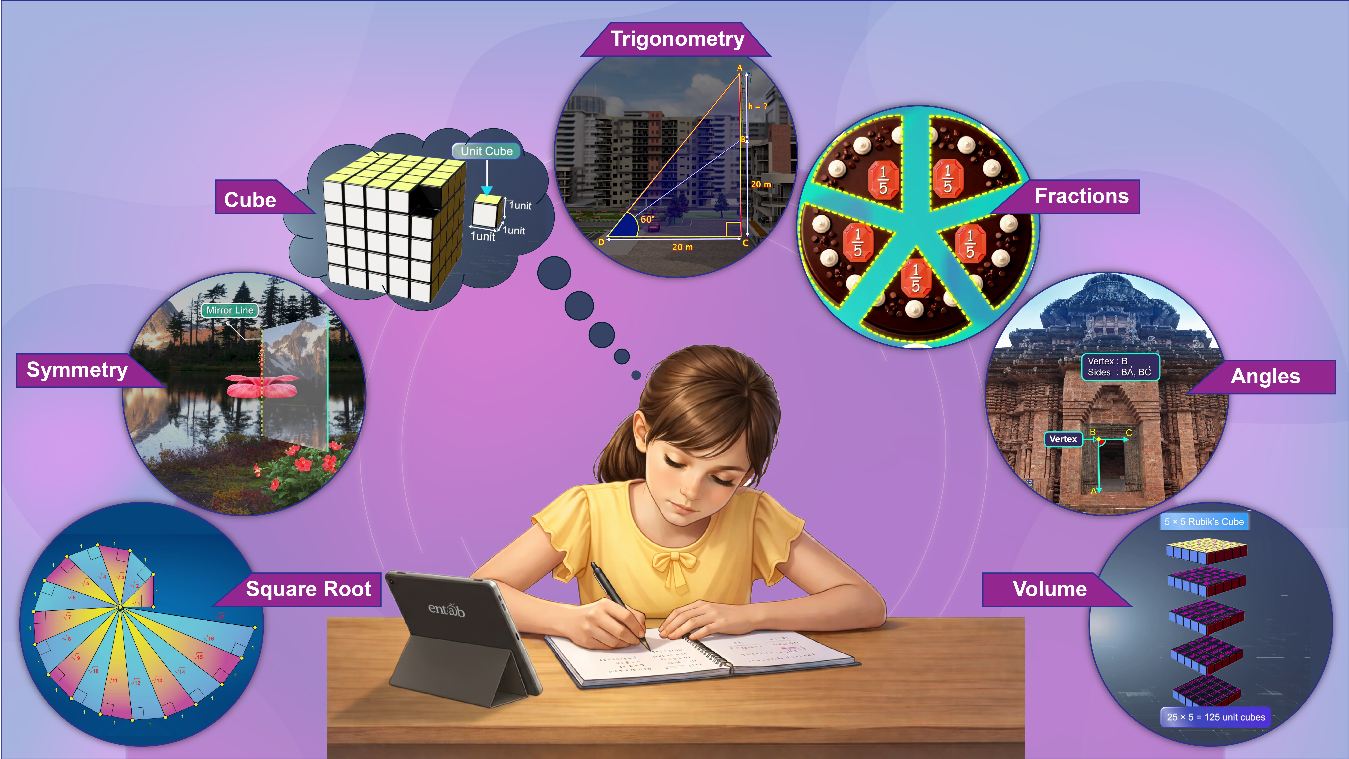
Mathematics naturally connects with a student’s daily experiences at every stage of their development. Rather than being textbook-bound, the new framework ensures that learning is hands-on, experiential, and meaningful.
Assessment in the NEP 2020 era is moving away from high-stakes final exams toward continuous evaluation. To provide a clear picture of holistic growth, teachers now utilize:
To successfully implement these pedagogical shifts, schools require robust LMS platforms. Entab’s Campus Care 10X seamlessly integrates teaching with assessment while promoting experiential learning.
Key features supporting the new framework include:
The shift brought by NCF-SE 2023 is a change in mindset. Mathematics is now a life skill—encompassing strong numeracy, critical thinking, and decision-making—rather than just an exam subject.